
How to Stop Abandoning Yourself to Keep the Peace?
A Black History Month Reflection

You’re Not “Too Much.” You’ve Just Been Too Quiet for Too Long.
Some of us learned early that peace meant making things easier for everyone else.Don’t say that.Don’t rock the boat.Don’t ask for more.Don’t correct them.Don’t make it awkward.
So you shrink. You smooth the moment. You swallow the truth. You choose being agreeable over being authentic—because authenticity felt risky. And maybe it worked for a while. Maybe it kept you safe.Maybe it helped you survive certain rooms, relationships, workplaces, and family dynamics.But the cost shows up later—when you realize you’ve been maintaining harmony on the outside while abandoning yourself on the inside.That’s not peace. That’s self-erasure with good manners.What Self-Abandonment Actually Looks LikeSelf-abandonment isn’t always dramatic. It’s usually subtle—and that’s what makes it so dangerous. It becomes your default.
It looks like:
Saying “it’s fine” when you’re not fine
Laughing to keep things light when something hurt you
Overexplaining your boundaries so people don’t label you “difficult”
Letting things slide until resentment becomes your personality
Accepting crumbs because asking for more feels like conflict
Silencing yourself to avoid being misunderstood
And if you’re Black, there can be an added layer: the pressure to be palatable.
To be “professional” in a way that really means less human.
To be “calm” in a way that really means less honest.
To be “resilient” in a way that sometimes means unsupported.

“‘No’ is a full sentence. It’s so important to give ourselves permission to make decisions that protect our peace.”
Black History Month Reminder: Your Peace Is Part of the Legacy
Black History Month isn’t only about what our ancestors endured. It’s about what they protected, insisted on, and built—even when the world told them to accept less.
Dignity is part of the legacy. Voice is part of the legacy. Self-respect is part of the legacy. And here’s the truth: the world has always benefited when Black people make themselves smaller. When we don’t speak up. When we absorb harm quietly. When we “keep it moving.” But comfort is not the same thing as peace. And silence is not the same thing as strength.
So this month, consider this a different kind of honoring:
Not just celebrating the fight for freedom in history—but practicing the fight for wholeness in your everyday life.
Peacekeeping vs. Peace
Peacekeeping is external. It’s performance. It’s conflict avoidance. Peace is internal. It’s alignment. It’s self-trust.Peacekeeping says:“I’ll betray myself so you don’t feel uncomfortable.”
Peace says: “I can love you and still be honest. I can be kind and still be clear.”
Peacekeeping asks: “How do I say this so nobody gets upset?”
Peace asks: “How do I say this so I don’t disappear?”
Why You Keep Abandoning Yourself (And Why It Makes Sense)Let’s be real—most people didn’t start self-abandoning because they were weak. They did it because they were adapting.
You might’ve learned that:
honesty created punishment
having needs created backlash
boundaries created distance
speaking up created labels
being direct created consequences
So your nervous system did what it’s designed to do: it protected you. But what protected you in one chapter can become a prison in the next. This is the shift: you don’t need to shame who you were. You just need to stop letting survival strategies run your whole life.
How to Stop Abandoning Yourself to Keep the Peace
Here are the steps—simple, real, and practical.
1) Catch the exact moment you leave yourself
Self-abandonment usually starts with a signal:
tight chest
forced smile
quick “it’s okay”
urge to rush past your feelings
inner voice saying “don’t make this a thing”
When you feel that, pause and ask:
“What do I actually want to say right now; if I wasn’t afraid of the reaction?”
That’s your truth. Start there.
2) Stop negotiating your needs like they’re optional
You don’t need permission to want what you want.
Try swapping:
“It’s not a big deal…”
with
“Actually, it matters to me.”
You don’t have to be harsh. You just have to be honest.
3) Use clean, simple boundaries (no essays)
You don’t owe a TED Talk every time you protect yourself.
Try:
“That doesn’t work for me.”
“I’m not available for that.”
“I’m going to pass.”
“I’m not comfortable with that.”
“Let me think about it and I’ll get back to you.”
Say it. Stop. Breathe.
Let the silence be awkward. You’re not responsible for managing everyone’s feelings.
4) Expect discomfort—and don’t let it be the boss
When you stop abandoning yourself, people who benefited from your silence may react.
They may guilt you.
They may act confused.
They may call you “different.”
They may test the boundary.
That doesn’t mean you’re wrong.
It means the relationship is adjusting—or revealing.
Repeat this……. Discomfort is not danger.
5) Stop calling it “peace” when it’s really avoidance
Be honest with yourself:
If you’re silent but anxious, that’s not peace.
If you’re agreeable but resentful, that’s not peace.
If you’re “fine” but drained, that’s not peace.
Peace feels like relief, not self-betrayal.
6) Choose self-loyalty one small moment at a time
You don’t transform overnight. You return to yourself daily.
A “self-return” can be:
texting the truth instead of ghosting
asking for clarity instead of assuming
naming what you need instead of performing okay
resting without explaining
leaving the room when you feel yourself shrinking
Tiny returns build strong self-trust.

“Not everything that is faced can be changed, but nothing can be changed until it is faced..
James Baldwin (1924–1987) was a Harlem-born writer and civil rights-era voice known for his fearless essays and novels on race, identity, and love. He rose to prominence with Go Tell It on the Mountain (1953) and later shaped national conversations through Nobody Knows My Name (1961) and The Fire Next Time (1963). Baldwin stood with Dr. Martin Luther King Jr. at the 1963 March on Washington and spent much of his life in France, where he wrote freely and spoke honestly about America.
Reflection Prompts
If you want to take this deeper, sit with these:
Where did I learn that my needs were “too much”?
Who benefits when I stay quiet?
Where do I feel resentment building—and what boundary is missing?
What truth have I been editing to stay accepted?
What would self-loyalty look like in one relationship this week?
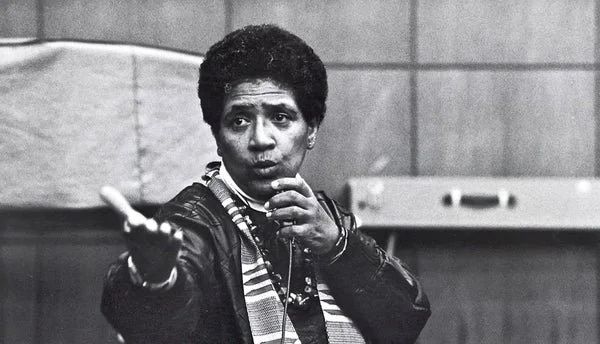
Caring for myself is not self-indulgence, it is self-preservation, and that is an act of political warfare.
-Audre Lorde
You Can Be Loving Without Losing Yourself
You don’t have to choose between being kind and being clear.
You don’t have to disappear to belong.
You don’t have to swallow your truth to be considered “easy.”
This Black History Month, let this be part of your honoring:
Not only remembering how far we’ve come; but practicing the freedom to be whole in real time. Because your peace matters.
And you deserve to be someone you don’t abandon.
If this hit home, share it with someone who’s been shrinking to stay safe. And if you’re ready to practice boundaries with support, coaching can help you build self-trust without losing your softness.
Want support? Book a free discovery call
